Estate security services combine a residential security assessment with on-site protection agents and coordination of the home’s cameras, access control and staff. For most high-net-worth homes the right starting point is the assessment: a walk-through of the perimeter, entrances, routines and online exposure that produces a written plan. Teams come after the plan, not before.
The houses that worry us are not the ones with no security. They are the ones with an expensive camera system, a gate code shared with forty people, and nobody whose job it is to notice.
What is estate security?
Estate security is the protection of a private residence and the people in it as a program: an assessment of the property and the family’s routines, a layered design of physical measures and technology, vetted people, written procedures, and, where the risk justifies it, licensed agents on site. It is run by a protection firm, not an alarm company.
That is the difference from a residential security system. A system deters an opportunist and records what happened afterward. Estate security anticipates a targeted risk: the person who has been watching the house, the former employee with the code, the fan who found the address, the contractor’s crew nobody vetted. A guard company sits in between: it supplies uniformed officers for a post, which is sometimes exactly what an estate needs and often is not.
Why an estate is a different problem from a house
A large residence has more of everything that creates risk: more entrances, more staff, more contractors, more deliveries, more guests, more predictable routines, and a far bigger footprint online. The address is in county records, on real-estate listings with interior photographs, and quite often in the background of a family member’s social media.
It also has a false sense of safety built in. Gates and walls feel like protection. To someone who has been watching, they are a schedule: when the landscapers arrive, when the gate opens for school, which nights the house is empty.

So the assessment starts outside the property line and ends on the family’s phones.
The three layers every estate plan is built on
Protection professionals think about a residence in three layers, each buying time and distance between a hostile person and the family.
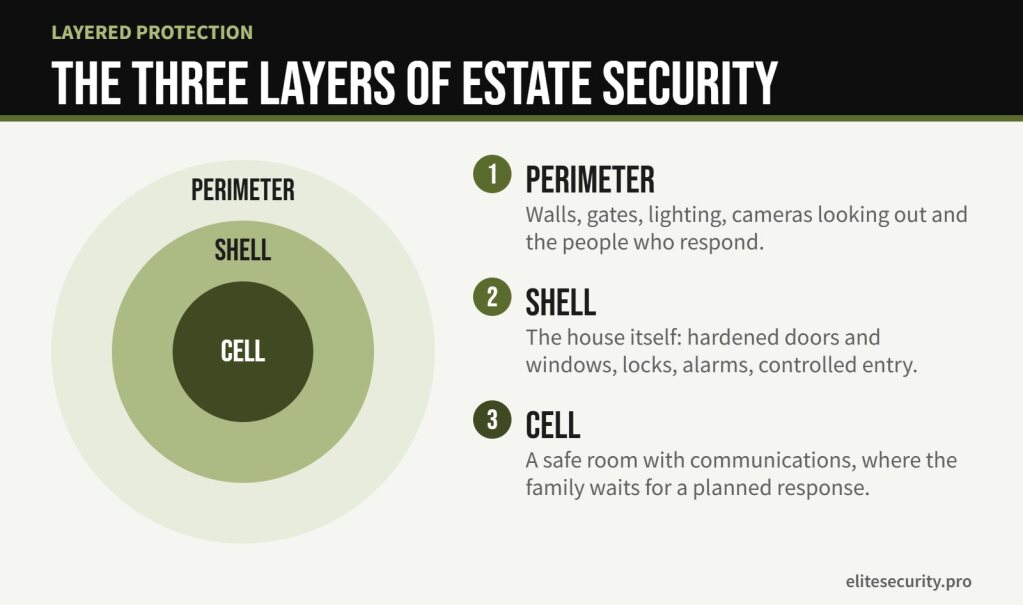
The perimeter. Walls, fences, gates, the approach roads, lighting, cameras that cover the outside looking out, and the people who respond when something crosses the line.

The shell. The building itself: hardened doors and windows, locks, alarm sensors, the garage and service entrances, and the rule that nobody enters without being expected.
The cell. The secure space inside the house, usually a safe room with communications, where the family goes if the first two layers fail and waits for the response they have already planned.
Technology supports all three layers. People and procedures make them work. A camera nobody watches is the perimeter in name only.
The estate security assessment: a 12-point checklist
This is the list we walk, in roughly this order. If you do nothing else this year, do this once with someone who does it for a living.

- Approaches and perimeter. Which roads lead in, where a vehicle can stop unobserved, where the wall or fence can be crossed, and what the neighbors can see.
- Gates and access control. Who has codes, fobs and remotes; when they were last changed; whether the pedestrian gate is on the same system as the vehicle gate.
- Cameras and blind spots. Not how many cameras, but what they actually cover, who is looking at them, and how long footage is kept. A camera nobody watches is a recording device for the police afterward.
- Alarm response. How long between an alarm and a human being at the door. In much of Dallas-Fort Worth the honest answer is fifteen to thirty minutes. The plan has to cover that gap.
- Lighting and detection. Where the dark is, especially along the approach a person on foot would use, and whether motion sensors and lighting give early warning or just a surprise.
- Staff and contractors. Who works in the house, who has been background-checked and when, how the landscaping and pool crews are vetted, and what happens to access when someone is let go.
- Deliveries and visitors. Where packages are left, whether drivers are let inside the gate, and how guests at an event are checked against a list.
- Routines and patterns. School runs, gym times, the day the house is empty, the car that is always in the same spot. Patterns are what an observer uses.
- Digital exposure. Whether the address is findable from public records, listings and data brokers, whether family members’ accounts are public and geotagged, whether children’s accounts show the house, the car or the school, whether the home network separates smart devices from the family’s data, and whether the principal has been doxxed before. On high-exposure estates this includes a counter-surveillance sweep for listening devices and hidden cameras.
- Safe room and medical. Where the family goes if someone is inside the house, how they call for help, and how far the nearest emergency care is.
- Event days. Parties and fundraisers are the one day a year the gate is open to strangers. They need their own plan.
- Secondary residences, travel and empty periods. The lake house, the beach house, the week the family is away and the house is unoccupied, and who checks it.
The output is a written plan: what is fine, what should change, in what order, and what kind of on-site coverage, if any, the estate actually needs.

The four team options
| Option | What it is | Best for | What drives the cost |
|---|---|---|---|
| Assessment only | The 12-point walk-through, a written plan, vendor coordination | Most estates, as the first step | Size of the property and depth of the threat review |
| Scheduled agent | One licensed agent on site for defined windows: overnight, event days, the week after an incident | Specific concerns, events, families who travel | Number of shifts and their length |
| Residential security team, 24/7 | Three or four agents rotating so the house is never without someone awake and watching | A credible threat, a very public principal, estates with heavy traffic | A full rotating team, every day of the month |
| Family detail plus residence | Close protection for the family’s movements combined with residence coverage | Principals with an active threat or a profile that follows them out of the gate | Scoped per program; see our executive protection cost guide |
Most estates we assess end up in the first or second row. A 24/7 team is expensive and visible, and it is only the right answer when the threat justifies it. We say so when it does not.

How much do estate security services cost per month?
It depends on which of the four options the estate needs. A one-off assessment is the smallest commitment. A scheduled agent is priced by the number and length of the shifts, so four overnights a month cost far less than a standing team. A rotating 24/7 residential team is the largest commitment, because it means three or four agents covering every day of the month. Post-based residential guards from a guard company cost less than close protection agents, but they are trained to watch a post, not to protect a family. The assessment tells you which option you need, and the confidential quote follows from it.
Working with the systems you already have
We do not sell alarm panels or cameras, and we do not install them. The estate usually already owns good equipment from a specialist vendor. What is missing is the operating layer: who watches, who responds, who holds the codes, what the plan is at 3 am.
The assessment produces a short list for the vendor (coverage gaps, retention, remote access, analytics that flag a person at the fence rather than a deer), a short list for the household (code discipline, visitor protocol, staff onboarding and exit), and a short list for the family (what to stop posting). On a 24/7 engagement the agents monitor the client’s own cameras from the client’s own system, with no new hardware required.

Household staff, contractors and confidentiality
The people with the most access to an estate are not the security team. They are the house manager, the nanny, the chef, the drivers, the landscapers and the pool crew, and most of them were never checked, or were checked once years ago.

The fix is procedure, not suspicion: a background check when someone is hired and renewed periodically, a confidentiality agreement for anyone who works inside the house, an onboarding briefing on what not to post and who not to let in, a vetting requirement passed down to contractors for their crews, and an exit procedure that changes codes and collects keys and fobs the same day someone leaves. Written down, these take two pages. Followed, they close more gaps than any camera.
The mistakes we see most
In no particular order, the patterns that come up in nearly every first assessment.
The gate code that has never changed. The house manager, the former nanny, the pool company from two years ago and a dozen guests all still have it.
The cameras that record but are not watched. A break-in on a Tuesday afternoon is reviewed on Wednesday.
The crew that was never vetted. The landscaping company was, three years ago. The crew has changed four times since.
The pool photo. A family member posts from the back yard with the skyline behind it. Anyone who wants to can now place the house on a map.
The alarm company’s response time, which nobody has ever measured.
The staff member who was let go on Friday and still has the garage code on Monday.
The smart home on the same network as the family’s laptops.
None of these needs a security team to fix. All of them need someone to notice.
What kind of security do billionaires have?
The very wealthy are protected in layers rather than by a person: an assessment that is refreshed as life changes, a hardened perimeter and shell with a safe room inside, technology that gives early warning, a residential team on the property, a close protection detail for movements, vetted household staff, written procedures, and usually a security director or family office that runs it all. How many bodyguards a billionaire has depends on the threat, not the net worth: one agent on travel days is common, a standing team is the exception. The model scales down. A family with one estate and no specific threat can run the same layers with an assessment, good procedures and a scheduled agent.

Estate security in Dallas-Fort Worth, Los Angeles and Florida
Elite Security Pro assesses and covers private residences, executive homes and offices in Dallas-Fort Worth as our home market, including Highland Park, Preston Hollow, Southlake, Frisco and Westlake, and in Los Angeles and Florida with the same standard. Our agents come from military, law enforcement or executive protection backgrounds, working under a licensed Texas security company that has done this for 24 years.
To arrange an assessment, request a confidential quote or call (972) 914-9037.
Frequently asked questions
What is a residential security assessment?
A structured walk-through of a home by a protection professional covering the perimeter, access control, cameras, alarm response, staff and contractor vetting, routines, digital exposure, emergency planning and event days. It produces a written plan with changes in priority order and a recommendation on whether on-site agents are needed.
Do I need 24/7 security guards at my estate?
Usually not. Round-the-clock teams are the right answer for a credible, specific threat or a principal whose profile brings strangers to the gate. Most estates are better served by an assessment, better process around codes, staff and visitors, and scheduled agents for overnights, events or the week after an incident.
Can estate security protect against doxxing and online exposure?
Partly, and the part that matters starts at home. An assessment identifies where the address and the family’s movements are findable: public records, listings, data brokers, social media, children’s accounts. The plan reduces that exposure and prepares the household for the day it is exposed anyway. Removing information from data brokers is a separate, ongoing task.
Do estate security agents work with my existing alarm and camera company?
Yes. We coordinate with the client’s vendor rather than replacing it. The assessment gives the vendor a short list of coverage and configuration changes, and on-site agents monitor the client’s own system during their shifts.
How is estate security different from a security guard company?
A guard company places uniformed officers at posts. Estate security starts with an assessment of how the household actually lives, fixes process before adding people, and uses licensed close protection agents who can move with the family as well as watch the house. The goal is a home that is hard to observe and quick to respond, not a visible guard at the gate.
What is the best security for an unoccupied house?
Make it look and behave occupied, and make sure someone responds. Lighting and blinds on schedules, mail and deliveries held, the alarm monitored with a named responder, cameras checked by a person rather than left to record, a trusted neighbor or house manager who walks the property, and no social media posts announcing the trip. For a high-profile estate, a scheduled agent check or a short-term residential post is cheaper than the incident.
Can private security put their hands on you in Texas?
Licensed security officers in Texas may use reasonable force to protect people and property and may detain someone until police arrive, under the same self-defense and defense-of-property rules that apply to any person. They are not police officers. A well-run estate team almost never touches anyone, because the plan is built to keep strangers outside the perimeter and to call law enforcement early.
Related services: Residential and Estate Security | Bodyguard Services and Close Protection | Executive Protection in Dallas-Fort Worth