Executive protection has no fixed price. The cost is set by the threat level, how many days need coverage, how many agents each day needs, whether the detail is armed, how much travel is involved and who the agents are. A licensed firm scopes the program in a short consultation and sends a written, confidential quote.
If you are reading this for a board, an insurer or a family office, the useful part is not a headline number. It is the structure of the cost, because that is what you will be asked to justify. Elite Security Pro quotes each program after a consultation, and the sections below explain what goes into that quote.
The main ways executive protection is bought
| Engagement | What it is | What usually sits inside it |
|---|---|---|
| Single day, one agent | One planned shift of 8 to 12 hours | Agent, planning call, communications during the detail, short report |
| Armed or premium agent | Commissioned, armed agents, often with federal or special-operations backgrounds | Level IV personal protection officer license in Texas, extra insurance |
| Advance work | A survey of each venue, route, hotel and exit before the principal arrives | Billed as agent time; a written movement plan |
| Threat assessment | A written review of the risks around the principal and family | Protective intelligence and recommendations |
| Monthly retainer | Agreed days each month with the same agents | Priority response, continuity, a lower effective cost per day |
| Round-the-clock coverage | Protection 24 hours a day for one principal | A rotating team of three or four agents, not one person |
| Travel or event team | Two or more agents with a team lead | Advances, travel days, coordination with venues |
| International detail | Protection abroad | Country risk, local partners, foreign licensing, longer days |
| Standing program | Year-round protection, contract, in-house or hybrid | Staffing, residences, travel and technology |

Each of these is quoted on its own scope. The rest of this guide explains what moves the number inside each one.
Why executive protection is priced by the day, not the hour
Guard companies quote by the hour because a guard works a post. Executive protection firms quote by the day because the agent’s work starts before the shift: the planning call, the advance, the intelligence check, the equipment, and the readiness to extend. Industry practice caps an agent’s working day at about 12 hours for safety, so a “day” means a shift of 8 to 12 hours, and anything longer needs a second agent or overtime.

That is also why an hourly figure and a day rate are hard to compare. An hourly price usually describes a guard-company style engagement with no advance. A day rate describes a planned detail. They are different products with the same name.
How much does private security cost per hour?
For a person rather than a building, it depends on what the hour includes. A security guard watching a post is the least expensive option, but is trained for a place, not for moving with a principal. A licensed close protection agent costs more, and an executive protection agent with an advance costs more again. Most firms also set a minimum booking, so a short engagement is billed as that minimum.

If you need protection for a few hours, ask whether the quote includes any advance of the venue. For an unfamiliar location, it is the part that matters most.
Why two programs that sound the same can cost very different amounts
A chief executive in Dallas with no known threat, a public schedule and a private driver can be protected for a month of office days and two events on a modest, scoped program. The same executive after a hostile layoff announcement, with a named person of interest and a family that is now identifiable online, is a different program: two agents, residence coordination, protective intelligence, and a plan for the school run. Both are “executive protection”. The second costs several times the first.
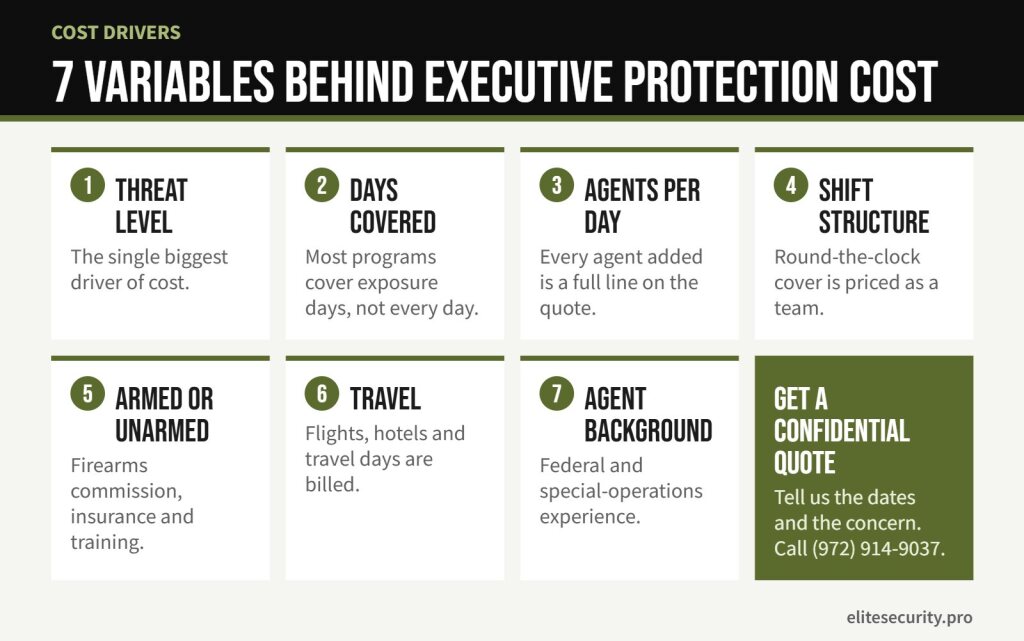
The number is driven by seven variables. Boards tend to ask about the first one and forget the last two.
1. Threat level. A credible, specific threat changes the number of agents, the posture and the planning hours. It is the single biggest driver of cost.
2. Days covered. Most corporate programs do not cover every day. They cover exposure: travel days, public events, the days around an announcement. A well-scoped program covers a handful of days a month, not every day.
3. Agents per day. One agent for low-profile office days. Two for public events or when the principal and a family member move separately. A team lead when three or more are deployed. Every agent added is a full line on the quote.

4. Shift structure. Round-the-clock coverage is not one agent. It takes three agents on rotation at minimum, and firms planning for rest days and backup use a four-to-one ratio, which is why 24-hour protection is priced as a team.
5. Armed or unarmed. Armed coverage costs more because of the firearms commission, insurance and training. In Texas the armed agent must hold the Level IV personal protection officer license. Most corporate details in Dallas and Los Angeles are unarmed by design.
6. Travel. You cover flights, hotels and daily expenses, and travel days are billed as working days. International work costs more than domestic work, adds foreign licensing and local partners, and often needs more agents.
7. The agent’s background. Agents with federal law enforcement or special-operations experience cost more than newly licensed ones. For a principal with a real threat, that difference is the best value in the budget.
How much does executive protection cost per month?
Monthly cost depends on how many days are covered and how many agents each day needs. A scoped retainer that covers a few office days and events is the lightest version. One agent on every working day is next. Round-the-clock coverage of one principal, or a two-agent team that travels, sits at the top.

The gap between the lightest and the heaviest version is the whole point of scoping. For occasional needs, book by the day. Once coverage becomes regular, a retainer usually wins, because it lowers the effective cost of each day. The bigger benefit is continuity. The same agents, who know the principal’s routine, the office, the family and the car, are what make a detail low profile. A new agent every week is visible by definition.
A retainer should state the days or hours included, the rate for extra days, the response time for unplanned coverage, and what happens with unused days. If it does not, it is a deposit, not a retainer.
How much does executive protection cost per year?
Year-round protection is priced as a program. A basic standing program covers one principal with a small team. A mid-tier program adds residential coverage and regular travel. A full program covers several residences, international travel and a dedicated team. The threat and the calendar set the size of the program, not the size of the balance sheet.

Contract, in-house or hybrid?
Contract executive protection, bought by the day or on retainer, suits intermittent needs, an early assessment period and interim cover. In-house teams suit permanent daily needs, but bring salaries, benefits, training, management and backup cover onto the company’s books. Below a certain level of regular spend, contract wins on flexibility; above it, hiring starts to make sense. Many families settle on a hybrid: a permanent lead plus contract agents for travel and events.
A worked example: a corporate quarter in Dallas
Hypothetical, to show how a program is scoped. A founder of a Dallas company that has just announced an acquisition. No specific threat, but a sudden public profile and an active comment section.
| Item | Scope | What drives its cost |
|---|---|---|
| Threat assessment and protective intelligence, once | Written assessment, exposure review of the founder and family | Depth of the online and family exposure review |
| Office days, 4 a month, one agent | Arrivals, departures, low profile | Number of days and length of each day |
| Public events, 2 a month, two agents plus advance | Advance the day before, two agents on the day | Agents per event and the advance |
| Travel, 1 trip a month, one agent, 2 days | Two travel days plus expenses | Destination, flights and hotels |
| Residence assessment, once | Survey, recommendations, vendor coordination | Size and layout of the property |
Bundled on a retainer, the office days and events cost less than booking them one by one. The result is a quarter that a board can defend, and a fraction of what the same board would spend after an incident.
What is included, and what quietly is not
Inside the day rate, at least at Elite Security Pro: the agent’s time for the agreed shift, the planning call, communications during the detail, and a written report afterwards. Some firms quote an all-inclusive day that also covers the agent’s flights and hotel; ask which model you are being quoted, because it changes how two quotes compare.
Outside the day rate, and worth asking every company about: vehicles (we plan routes and work with the client’s drivers; we do not operate a fleet), travel expenses, overtime beyond the agreed shift, additional agents added mid-engagement, technical surveillance countermeasures, and specialist support such as a residence survey or protective intelligence beyond the initial assessment.

Extras like these can add a lot to a first estimate. A good scope says which of them apply to you before the engagement starts, so the invoice matches the quote.
What the agent earns versus what you pay
The agent does not receive the full day rate. The difference covers the company’s license and insurance, the backup agent on call, the advance and planning hours you never see, training, equipment and the cost of turning down work that does not fit.
An agent who is paid badly is the one to worry about. A company that underpays its people is cutting the same corners everywhere else.
How we price a program
The consultation takes about 20 minutes. We ask about the principal, the calendar, what has changed, what is worrying the people around them, and what the protection should look like from the outside. Within a day you receive a written scope: days, agents, posture, inclusions, exclusions, and either a per-day price or a retainer.

What you are paying for, in the end, is judgment. Our agents come from military, law enforcement or executive protection backgrounds, working under a company that has done this for 24 years. Elite Security Pro is a licensed Texas security company. We cover Dallas-Fort Worth as our home market, and Los Angeles, Florida and Nashville with the same standard.
For a quote tied to your calendar, request a confidential quote or call (972) 914-9037.
Frequently asked questions
How much does executive protection cost per day?
It depends on the length of the shift, the number of agents, whether the detail is armed and whether the venue needs an advance. A day usually means one shift of 8 to 12 hours, including planning, communications and a report. Vehicles, travel expenses and overtime are extra unless the quote says all-inclusive.
How much does executive protection cost per month?
Monthly cost depends on the days covered and the agents per day. A scoped retainer for office days and events is the lightest option; one agent every working day, round-the-clock coverage or a two-agent travel team cost progressively more. A retainer usually lowers the cost of each day compared with booking day by day.
How much does private security cost per year?
Year-round protection is priced as a program, from a basic standing program for one principal to a full program covering residences, international travel and a dedicated team. Most principals are better served by a scoped program that covers the days of real exposure rather than every day of the year.
Is it expensive to hire a bodyguard for a single day?
Compared with a security guard, yes; compared with the cost of an incident, no. A single day with one licensed agent is the simplest engagement there is. Our guide to how much a bodyguard costs covers short engagements in detail.
What does a threat assessment involve?
A written review of the risks around the principal and family, the online exposure, the routine and the locations, with recommendations. At Elite Security Pro the initial assessment is part of every program; a standalone assessment is also available on request through our contact page.
Is executive protection tax deductible for a company?
Often, when the protection is provided because of a documented business-related security concern, but that is a question for your tax adviser, not a security company. A written threat assessment is the document most advisers ask for first, which is one more reason to start every program with one.
Related services: Executive Protection | Request a Confidential Threat Assessment | Residential and Estate Security